
Article Summary
- The statewide numeracy plan is intended to guide teachers, schools and districts in developing strategies for improving student math performance.
- The plan is modeled after the comprehensive literacy plan the state board of education adopted in 2024.
- State and national test scores have shown proficiency rates in math are consistently below those in English language arts.
This summary was written by the reporters and editors who worked on this story.
SPRINGFIELD, Ill. (Capitol News Illinois) — The Illinois State Board of Education formally adopted a plan Wednesday aimed at improving math instruction and boosting student math scores throughout the state.
The Illinois Comprehensive Numeracy Plan is described as a “first-of-its-kind” framework in Illinois for guiding schools and districts in strengthening math teaching and learning.
The plan comes on the heels of the comprehensive literacy plan that the board approved in 2024.
State Superintendent of Education Tony Sanders noted that the literacy plan grew out of multiple competing legislative proposals calling on the state board to do something to improve students’ reading and writing skills.
“It immediately became noted across the nation as a model for how to go about developing your plans around curriculum instruction and how to move practice in classrooms,” Sanders said. “And so I told the team, before the legislature asked us to do it, let’s proceed forward with a numeracy plan.”
Sagging math scores
For years, average student test scores in math have been far below those for English language arts. According to the most recent state report card, only 38.4% of Illinois students met the state’s standards for proficiency in math. That compares with 52.4% in English language arts.
The report card also showed wide achievement gaps between racial, ethnic and economic subgroups of students.
Illinois is not alone in that regard. Results from the most recent National Assessment of Educational Progress — also known as the nation’s report card — only 59% of U.S. eighth graders scored at or above the “basic” achievement level in math compared to 66% who did so in reading.
Those persistent differences in achievement levels have become so common that many people take them for granted. But ISBE board member Donna Leak said it’s time for that attitude to change.
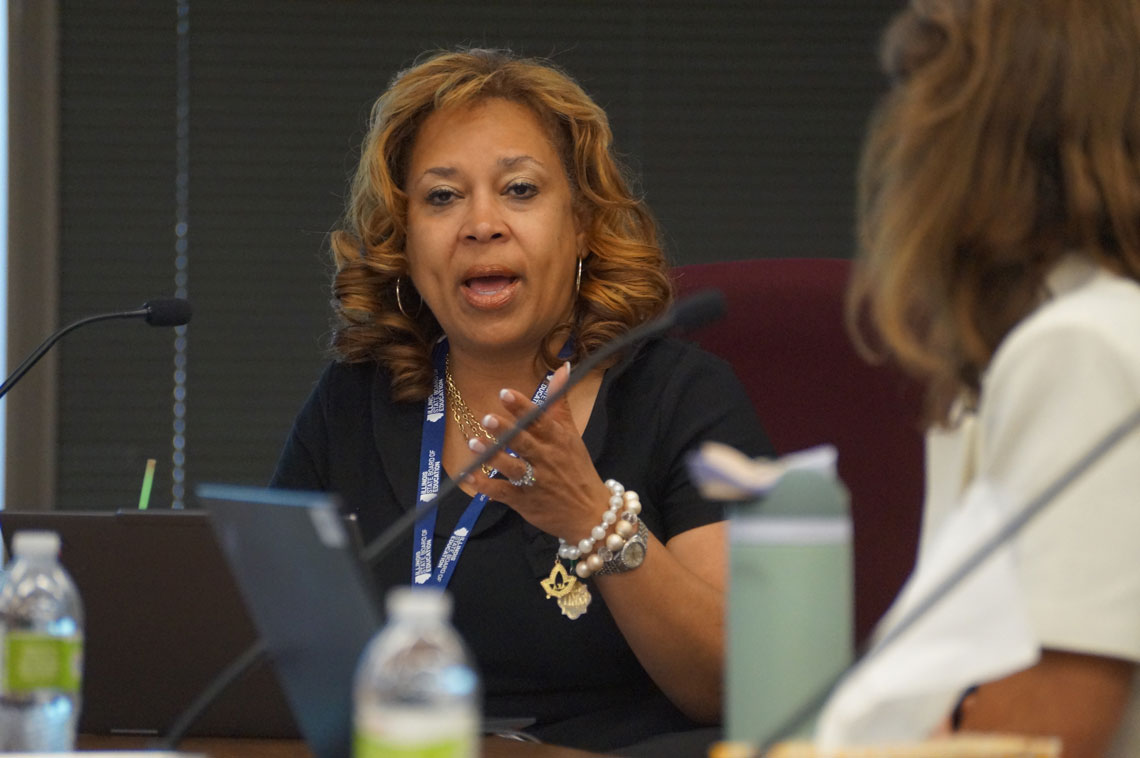
“One of the things that I always have struggled with is people say, ‘Oh, you know, I don’t do math. I’m not a math person,’” she said during Wednesday’s board meeting. “Nobody ever says ‘I don’t read,’ right? So how do we take away that stigma of mathematics being something that is unattainable for everyone?”
Attacking the math problem
The 192-page numeracy plan is intended to give classroom teachers as well as building and district officials guidance about how to work together to improve the way math is taught.
It starts by defining “numeracy” as “the ability for all students to confidently understand, interpret, and apply mathematical concepts across all domains of mathematics in a variety of real-world and academic contexts.”
It then sets out three sets of goals, focused on students, educators and leaders.
Students, it says, should “build and apply numeracy skills through tasks that develop reasoning, fluency, and real-world problem-solving.”
It calls on teachers to use “evidence-based numeracy instructional strategies to strengthen students’ mathematical understanding and confidence.” And educational leaders should “promote a culture of numeracy through targeted professional learning and data-informed instructional support.”
“A lot of our plan focuses on what teachers should do,” Ronda Dawson, ISBE’s executive director of teaching and learning, told the board. “But it’s equally important for leaders to know what they’re looking for, how they’re using their data to support the development of their own plans.”
Specifically, the plan calls for teachers to work collaboratively both “horizontally” within a given grade level and “vertically” across grade levels to ensure students “experience mathematics as a logical progression of ideas rather than isolated skills.”
It also calls for more intensive professional training for teachers, beginning with their initial training programs in college and continuing with in-service training throughout their teaching career.
Kirsten Parr, ISBE’s director of standards and instruction, said the plan went through several iterations before the final document was presented to the board Wednesday and involved input and feedback from thousands of individuals.
She said the process involved a statewide needs assessment survey in April 2025 that was distributed to teachers, building and district leaders, regional superintendents, university schools of education and other stakeholders.
Following a summit meeting in June 2025, draft plans were circulated for public comment through focus groups and two rounds of listening tours with educators, stakeholders and community members throughout Illinois.
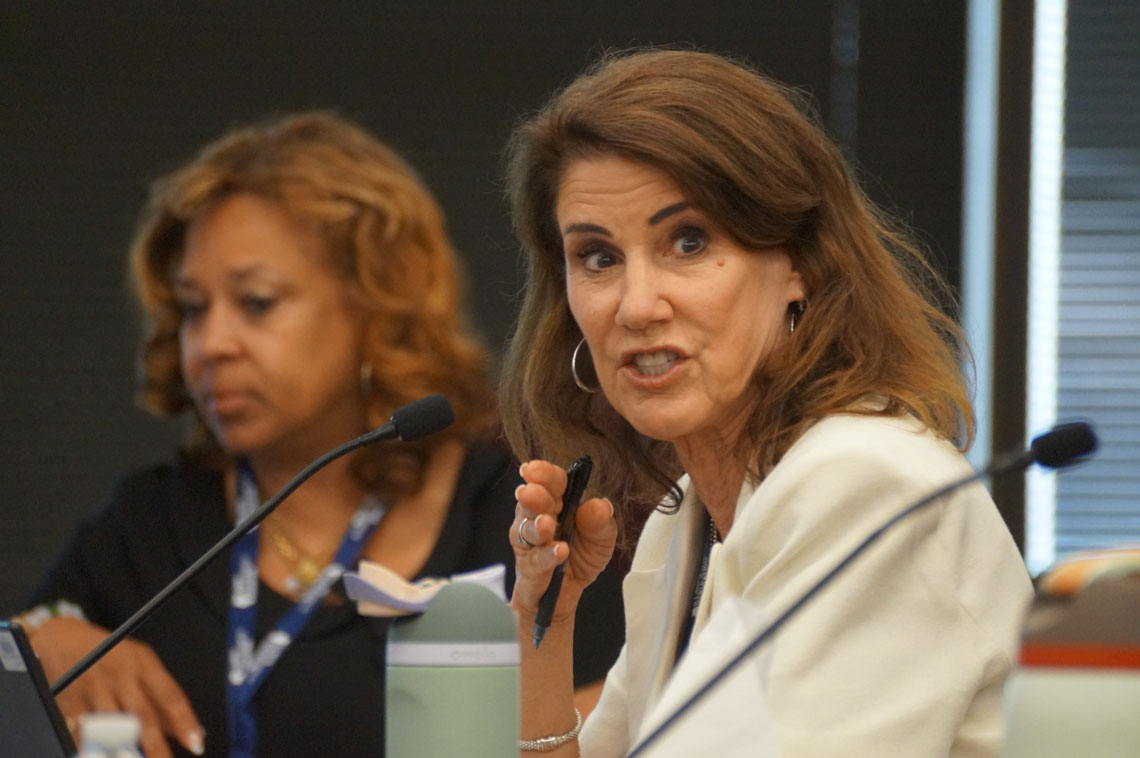
“People were talking about this work and about the impact this work would have in classrooms, schools, districts, communities across the state,” she said. “And for that elevation and discussion to take place really was the culmination of all of the thoughtful work that had gone on behind the scenes here at ISBE.”
ISBE said in a statement Wednesday that the plan does not mandate that districts adopt any specific curriculum or programs. Instead, it provides a “flexible framework that districts can adopt or adapt based on local needs.”
ISBE said it will support implementation of the plan through professional training, tools and resources that will be updated regularly on the agency’s website.
(Reporting by Peter Hancock, Capitol News Illinois)
Capitol News Illinois is a nonprofit, nonpartisan news service that distributes state government coverage to hundreds of news outlets statewide. It is funded primarily by the Illinois Press Foundation and the Robert R. McCormick Foundation.
This article first appeared on Capitol News Illinois and is republished here under a Creative Commons Attribution-NoDerivatives 4.0 International License.



Comments